
Warehouse Flooring Perth
Forklift-rated floor coatings for warehouses and distribution centres across WA. Dust-free, easy to sweep, and marked out for traffic and racking in the same visit.
- Rated for forklift and pallet jack traffic
- Stops concrete dust getting into stock and racking
- Line marking and demarcation applied with the floor
- Staged so you keep operating through the works
- 2+ year product and workmanship warranty
The Dust Is Costing You More Than You Think
A bare warehouse slab never stops breaking down. Every forklift pass grinds a little more off the surface, and that dust goes into the racking, onto the stock, into the packing area and through the roller doors into everything else.
Businesses that seal the floor usually notice three things within a month. Cleaning takes less time. Stock comes off the racking cleaner. And the floor stops getting worse, because the surface that was wearing away is now protected.
The other half of the job is traffic. A coated warehouse floor takes forklift wheels, pallet drops and dragged steel without pitting the way bare concrete does, and it takes line marking that stays legible instead of wearing off in six months.
Free Quotes Within 48 Hours
What Goes Into A Warehouse Floor
A build rated for the traffic
Forklift wheels concentrate a lot of weight into a small contact patch, and a thin coating will not survive it. We set the build thickness against the machinery you actually run and the loads you actually move.
Line marking and demarcation
Walkways, racking bays, pedestrian exclusion zones, loading areas and hazard markings. Applied as part of the coating rather than painted on top afterwards, so it does not wear off under traffic.
Grip where it is needed
Loading docks, ramps and areas near roller doors get wet, and those are the places people slip. We can lift the slip rating in specific zones without making the whole floor harder to sweep.
Joint and crack treatment
Movement joints get treated properly rather than coated over, because a coating bridged across a moving joint will crack and start lifting at the edges.
Colour zoning
Different colours for different functions – despatch, receiving, quarantine, staging. It makes a large floor readable at a glance and it costs very little extra at the time of installation.
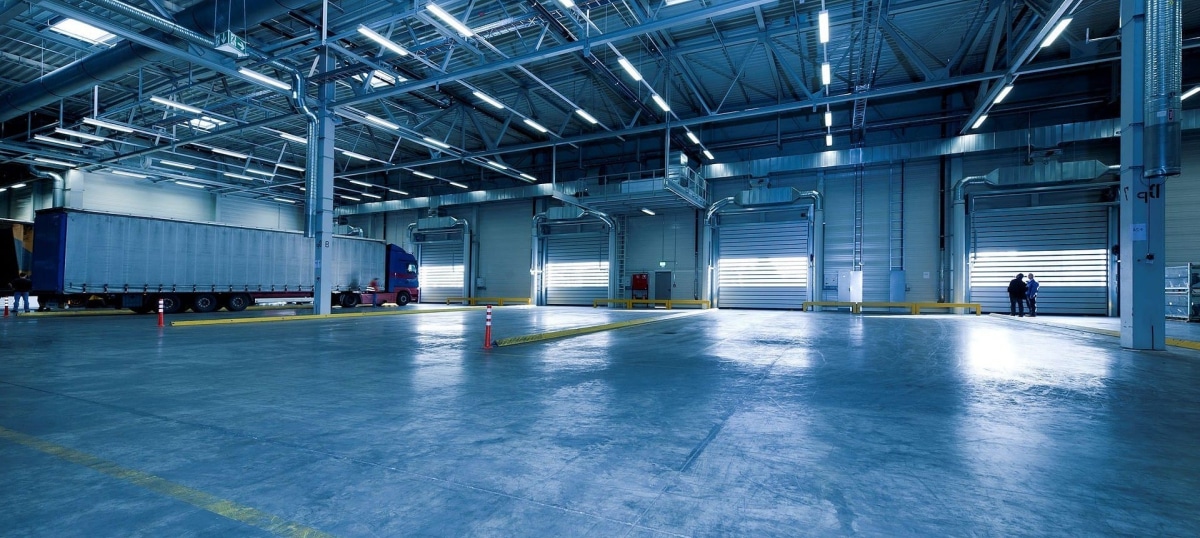
We Work Around Your Operation
Very few warehouses can empty out for a week. Most of our warehouse work is staged – we take a section, prepare and coat it, hand it back, then move to the next one while you keep running.
That usually means working nights, weekends or around your despatch windows. We work out the staging at the site visit based on what you can clear and when, and it goes into the written programme so there are no surprises.
Fast-curing systems mean a section can often be back under traffic the next morning.
Preparation In A Working Warehouse
Warehouse slabs are usually older, larger and in worse condition than people expect once you look closely. Common findings are surface wear along the main traffic runs, pitting and spalling around dock levellers, oil and hydraulic fluid contamination near maintenance areas, and cracking that has opened up over years of loading.
All of that gets dealt with before coating. Diamond grinding or shot blasting back to sound concrete, crack repair, patching of spalled areas and treatment of contamination. We use dust-extracted equipment so the preparation itself does not spread through the building.
What To Expect
- Site visit
We walk the floor, look at the wear patterns, test for moisture, check the joints and talk through your traffic, your racking layout and your access windows. - Specification and quote
System, build thickness, slip rating, line marking layout and staging plan. In writing within 48 hours. - Staging plan
Which sections, in what order, and when. Agreed before we start so your team can plan around it. - Preparation and coating
Section by section, with dust extraction, so the rest of the building keeps working. - Line marking
Applied as part of the same programme rather than as a separate job later. - Handover
Data sheets, cure times and a maintenance rundown for your cleaning team.
2+ Year Product & Workmanship Warranty
We offer a 2-year warranty on commercial and a 5-year warranty on residential projects for your lasting peace of mind.
What Our Clients Say
Warehouse Flooring Questions
Do we have to shut down?
Almost never. We stage the work into sections and coat outside your operating hours, so you keep running through the programme. We work out how to break it up at the site visit.
Will it take our forklifts?
Yes, provided the build is specified for them. Tell us what you run and what you move, and the build thickness gets set against that. This is the number one thing that gets underspecified on cheap warehouse quotes.
Can you do the line marking at the same time?
Yes, and it is better that way. Marking applied as part of the coating system wears far better than paint applied over the top later, and doing it in one programme means one lot of disruption instead of two.
Our floor has cracks and pitting. Is it too far gone?
Usually not. Cracks get cut out and repaired, spalled areas get patched, and worn surfaces get ground back. It is rare that a warehouse slab is beyond coating – if yours is, we will tell you at the site visit rather than after you have paid for it.
How long does it take?
It depends on the area and the staging. A single section is usually two to three days including preparation. Large floors run over several weeks in stages, but no single area is out of action for long.
Will the dust from grinding get into our stock?
We use dust-extracted preparation equipment and we screen off the working section. It is one of the reasons staging works well – the rest of the building stays clean while we work.
How do we clean it afterwards?
A sweeper or a scrubber, depending on the size. No harsh chemicals needed. Keeping grit off the surface is what makes a warehouse floor last, because grit under a forklift wheel is what wears it.
Do you work outside the Perth metro?
Yes, across regional WA.
Get A Price On Your Warehouse Floor
Tell us the floor area, what machinery you run and what access windows you can give us. We will come out, walk the floor and put a written scope, staging plan and price in front of you within 48 hours.
