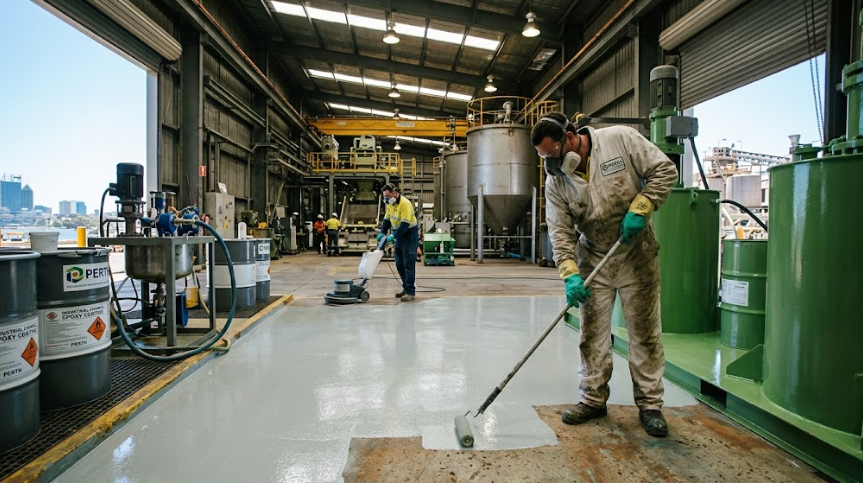
Chemical-Resistant Epoxy Coatings for Perth Mining and Manufacturing Facilities
A floor coating that fails inside 18 months costs more than doing it right the first time.
We see the aftermath regularly across Perth’s mining and processing sites: blistered surfaces near acid contact zones, chalky patches where alkaline wash-down has destroyed the coating’s grip on the concrete, and edges that have peeled away around bunded areas (contained zones designed to catch chemical spills) that were specified with standard commercial epoxy.
The root cause is almost always misspecification, not a failure of epoxy as a material class. Someone chose a product based on upfront cost or familiarity, without accounting for the heat, chemicals, and physical wear the floor would actually face in service.
When the Problem Is the Specification, Not the Product
Standard epoxy is a good product in the proper situation, and we use it on a regular basis in commercial warehouses, office fit-outs and light-industrial settings with controlled environments and low chemical exposure.
The issue is that it keeps getting specified into environments that differ from that. Mining and heavy processing facilities in WA expose floors to concentrated acids, high-pH caustic solutions, steam cleaning cycles, hot chemical wash-downs and constant wet processing conditions.
None of these are conditions a standard epoxy is designed for, and specifying it anyway is exactly what creates the failure patterns for which we’re called in to fix.
For a breakdown of where standard epoxy does perform well, we wrote in our post on the benefits of commercial epoxy flooring some of the conditions it is actually made for.
What Failure Looks Like on Site
The most significant failure we diagnose is alkaline solutions penetrating the resin from below and disrupting the bond between the coating and the concrete.
Sodium hydroxide (a powerful caustic agent typical of mineral processing) is commonly applied in mineral processing and is the primary cause of the chalky white blisters we frequently observe close to the points of chemical contact.
Once that bond begins to break, destruction proceeds quickly.
Moisture and further chemical ingress get under the coating and speed up the deconstruction.
A floor that already looked okay can ultimately require a full strip-back, substrate repair, plus reinstallation and expensive downtime.
Among the usual indications that the coating is already failing are:
- Chalky white blisters near chemical exposure areas.
- A soft or hollow-like area underfoot.
- Joints, edges, or bunded sections are given a localised lift.
- Cracking or movement after repeated wash-downs.
- Fast wear in chemical- and traffic-prone areas.
Thermal shock is the second failure mode that can surprise facility managers, but Perth makes the problem worse.
Slab temperatures in summer can exceed 50°C on open or semi-open facilities such as Kwinana and Welshpool.
When steam cleaning or chemical wash-downs are then applied to hot slabs, the rapid temperature change induces a marked strain on the coating bond line.
Standard epoxy systems applied too thinly cannot handle daily pressurised chemical wash-downs. This causes a cumulative loss of adhesion that builds up over time.
By the time lifting or cracking emerges, the system is typically failing from below.
Knowing how long a coating should last under natural conditions can help you spot early symptoms of failure.
Then, the heavy plant doubles down, accelerating the damage.
Forklifts, skid steer loaders, and steel-tyred equipment shifting over a chemically weakened surface could turn an early coating problem into a larger structural failure in the same operating period.
The Conditions That Change the Specification
When a client reaches out to us following a coating failure, we work back through the site conditions that contributed to it.
In the majority of those cases, one or more of the following were present but not factored into the original product selection: direct contact with acids, caustics, solvents or fuels at any concentration; regular exposure to strongly acidic or alkaline substances; steam cleaning or hot wash-down temperatures above 60°C; continuous wet or fully immersed conditions; or bunded areas required to contain chemical spills.
If two or more of those conditions exist on a single site, the specification discussion needs to start from scratch with the actual site demands driving the decision. The cheapest coating at installation is rarely the lowest total cost.
Once you factor in early failure, full removal of the failed coating, concrete repair, downtime and reapplication, the numbers look very different – and that’s a calculation we walk through with clients before anything is specified.
Polyurethane Cement for Wet and Chemical-Exposed Areas
For wet process areas, acid bays, reagent rooms and wash-down zones, polyurethane cement is the system we reach for first. It outperforms standard epoxy on heat resistance, moisture tolerance and resistance to the aggressive chemical exposure common across mineral processing and food manufacturing sites in WA.
One practical advantage that matters on Perth projects is its tolerance for damp concrete. Standard epoxy primers require a dry concrete surface, which creates scheduling problems on projects with tight timelines or during winter months when concrete holds moisture longer. Polyurethane cement avoids that constraint, and we have used it on a number of shutdown projects where extended drying time simply was not available in the programme.
Because of that flexibility, polyurethane cement reduces project risk without compromising the performance of the final system, which is why it is our preferred specification across wet processing and wash-down zones in Kwinana, Welshpool, Malaga and the northern industrial corridor.
Where chemical exposure is particularly severe, we topcoat the polyurethane cement base with a novolac epoxy layer, combining the heat and wet-weather durability of the base layer with the stronger chemical protection of the topcoat.
That combined system is the specification we use across several reagent handling and chemical storage areas in the Kwinana Industrial Area, where coating failures carry safety and compliance consequences well beyond the cost of the floor itself.
Novolac Epoxy for High-Concentration Chemical Exposure
If chemical contact with concentrated acid, solvent or corrosive materials is the problem, then novolac epoxy is the right choice. It has better resistance to chemicals than a general epoxy coating; which is also why it is selected for containment bunds, chemical storage areas and reagent handling zones that need regular direct contact with aggressive chemicals.
Novolac is a more rigid material than polyurethane cement and this means that substrate condition is more important before use. Prior to coating, cracks and movement joints are treated rather than coated over, applying it at a much greater thickness than a usual coating until we reach the protection level the site actually needs.
What we address directly with every client, especially those considering novolac, is the fact that no coating is required over untreated defects in the concrete. The system is stiff, so any movement at an untreated crack or joint will directly transmit through the coating and cause a localised failure; hence, the upfront substrate work has to be done. It is what decides whether or not the overall system will perform as it is intended.
Multi-Layer Systems for Complex Facilities
Larger manufacturing (and processing) facilities in Perth, for example, typically lack consistent floor requirements across the entire site. Within the same building in our multi-zone processing plants, we find three or four different performance needs, which are abrasion resistance in high-traffic corridors, chemical protection in process areas, and anti-slip or anti-static performance in wet or electrical risk zones.
We go about grinding and priming the surfaces and then apply a chemical-resistant main coat, adding anti-slip grit in wet areas, before finishing with a protective topcoat that will be designed to suit the traffic and chemical requirements of the specific zone. We take a record of the thickness of each coat applied, so the client has reliable information for maintenance scheduling and compliance audits.
That documentation is more important than most of the customers initially realise. When a coating system is due to be maintained or a zone is in need of repair, having accurate records of what was applied, when, and how thick enables maintenance teams to specify compatible products and eliminate the possibility of unsuitable topcoat systems being applied onto existing chemistry.
How Site Location in Perth Affects What We Specify
For example, the precincts in Perth are not interchangeable in terms of flooring specifications. Local environment, site history, and substrate condition vary enough by geographic area that we need to adjust our advice. A coating system that works in Malaga might not work for a Kwinana facility, and vice versa.
Kwinana Industrial Area
Petroleum refining, mineral processing, fertiliser manufacturing, and chemical storage are in close proximity in the Kwinana Industrial Area. In that environment, the implications of a containment coating failure extend well beyond the floor itself.
Kwinana’s proximity to Cockburn Sound also means coastal chloride exposure is a real factor for concrete substrates. For this reason, we use moisture-tolerant epoxy primers exhibiting chloride-blocking properties as standard for Kwinana projects, not as an upgrade.
Welshpool and the eastern manufacturing belt
In Welshpool and the eastern manufacturing belt, the sites we examine are typically old and oil, fuel, and hydraulic fluid contamination (which has been introduced into the concrete over years of operation) is commonplace. That contamination is largely invisible, but it can prevent primer adhesion and cause delamination within months if untreated before a coating begins.
Shot blasting (a mechanical process that removes surface contamination and opens the concrete), degreasing, and chemical neutralisation before priming are not a matter of choice on these sites. They are the steps that determine whether a Welshpool floor coating will work well or fail early.
To the workshop and equipment maintenance facilities located in this corridor, we usually provide a medium-build epoxy base with a solvent-resistant polyurethane topcoat suited to regular contact with diesel, gear oil, and cutting fluids.
Malaga, Wangara, and the northern industrial corridor
Malaga, along with Wangara and the northern industrial corridor, presents different demands. In such places, food manufacturing, pharmaceutical, and light processing facilities typically require hygienic and slip-resistant surfaces.
In wet process zones, we also use AS 4586 when designating the specific desired finish so that anti-slip aggregate is incorporated into the system from the beginning rather than tacked onto it late in the process.
We also consider the summer heat in Perth and plan our installations across the northern corridor accordingly.
Some epoxy primer systems are limited to an air and concrete surface temperature of around 35°C, and warm concrete can release trapped moisture as gas during the day and can cause pinholes when applying if the application time is not carefully controlled.
For Malaga and Wangara installations, we make sure coatings will be done in the early mornings, with smaller windows to be installed to product tolerances and not to cause adhesion problems that come from site conditions and not necessarily product performance.
The Preparation Step That Determines Long-Term Performance
Concrete preparation quality significantly influences long-term coating performance, surpassing the impact of product specification delivery.
A novolac epoxy system installed over a poorly prepared substrate will often fail faster than a standard epoxy applied to a properly roughened, decontaminated, and primed slab.
In our assessment of failed coatings at Perth industrial sites, inadequate surface preparation is recognised as the most common contributing factor.
The pattern is familiar: a facility takes a competitive quote that reduces the preparation time, the floor looks good at handover, and delamination can start within 6 to 12 months as the primer bond breaks down due to untreated contamination.
“We have walked into facilities where the coating looked fine on day one but was already failing underneath. Nine times out of ten, the preparation was cut short. No product can compensate for a substrate that was never properly ready.” – PM Industries Site Assessor
The essential preparatory steps are:
- Diamond grinding to the correct surface profile for coating adhesion.
- Contamination testing before coating.
- Neutralising chemical residues in the affected areas.
- Removal of oils, dust, and embedded surface contaminants.
- Priming only after the slab is properly profiled and stable.
This process adds some initial time and cost to the project. However, it prevents the massive expense of a full strip-back and reinstallation later.
On an active processing site, that doesn’t only mean additional labour and materials. It also translates into downtime, disruption and the cost of removing a floor from service again.
So we clearly define the trade-off in our first assessment. Preparation is where costs tend to be cut but it is also the one step that most often determines whether the system will continue to perform well or start failing in the first year.
Planning a Floor Coating Project for Your Facility
If you are assessing an industrial floor coating project for a mining, processing, or manufacturing facility in Perth, the most useful first step is a thorough site assessment before any products are specified. The chemical exposures, mechanical loads, substrate condition and operational constraints at your facility determine the correct system, and those variables are specific to your site, not to a product data sheet.
We carry out site assessments across Perth’s industrial areas from Kwinana to Welshpool and the northern corridor covering chemical exposure, concrete condition and system recommendations based on what we find on site. If you have had a coating failure and are not sure whether the issue was specification, preparation or a combination of both, contact our team before committing to a replacement system.
For facilities with lower chemical exposure and more controlled operating conditions, our post on the benefits of commercial epoxy flooring covers how the specification process and product selection differ when the demands on the floor are less severe.
What site conditions are you working with? If you are at the planning stage for a coating project, get in touch and we can walk through the assessment with you before anything is specified.